
General information about finnish nautical charts
Both paper and electronic nautical charts are produced in Finland, by the Finnish Transport and Communications Agency.
On this page
- Nautical Chart Brochure
- Chart symbology
- Coordinate system
- Reference Systems for Depths and Vertical Clearances in Nautical Charts
- Current Water Level Information
Nautical Chart Brochure
Traficom publishes an annual Nautical Chart Brochure, which includes a product catalogue and chart images showing the coverage areas of nautical chart products, as well as information on current topics.
Chart symbology
Printed nautical charts are produced according to the international (INT) symbology. The chart symbology is based on the international standard S-4 of the International Hydrographic Organization (IHO). You can familiarize yourself with the standard on the IHO website. The nautical chart publication Chart 1 (Marine chart symbols) explains all the symbols and abbreviations used on nautical charts.
Below is a link to the symbols used on Finnish nautical charts and a link to IHO's international standard S-4.
The new way of illustrating rocky areas on nautical charts eases safe navigation
The Finnish nautical charts include multiple different symbols for rocks. Beside the single symbols a new symbol has been introduced to represent widespread foul areas. These areas are very rocky and navigating within these is very risky.
The new way of illustrating foul areas will reduce the number of rock symbols and the charts will be clearer and easier to read. However, the new chart symbol will not completely replace the use of single stone symbols.
The foul area symbology is based on international nautical chart symbology. A foul area refers to an area where all dangers to navigation are not charted individually. Navigation through the area may be hazardous (IHO S-4, B-422.9). The foul area is outlined with a danger curve, a black dotted line (IHO S-4 B-420.1). It should be noted that the danger curve can be used to illustrate different types of obstacles for mariners, a symbol within the danger curve indicates what kind of danger is present in the area.
From a navigation safety point of view, the new symbology makes it clearer to mariners which areas are rocky and hazardous to navigate. The new area symbol also supports the use of chart plotters as risks related to over-zooming of the chart data, such as distortion of individual rock symbol positions are reduced. When navigating in an area which is illustrated as foul area on the nautical chart, special care should be taken!
The new symbology will be introduced on charts with the N2000 chart reform starting with the Bothnian Sea charts (chart folio E).
For more information, contact charts@traficom.fi
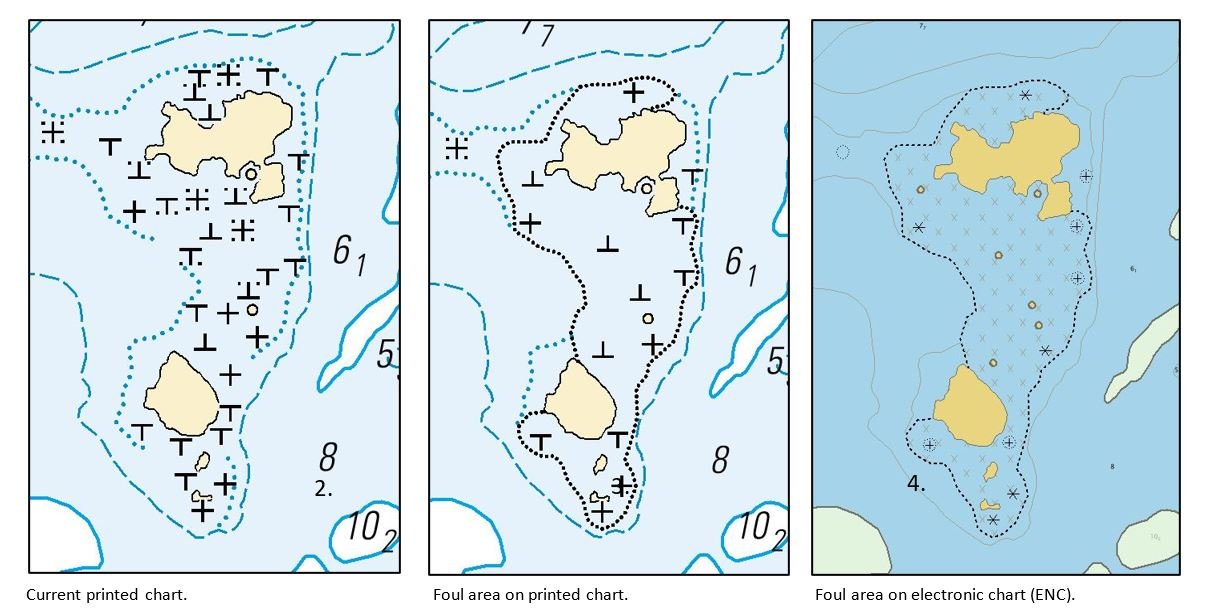
Examples of a foul area on the nautical chart.
Coordinate system
The coordinate system of Finnish nautical charts, EUREF-FIN, is based on the international maritime standard WGS 84 coordinate system, which is also used by the GPS satellite system. EUREF-FIN aligns with the WGS 84 coordinate system with an accuracy of about one meter, so in practical navigation, the difference between the coordinate systems does not need to be taken into account. In the list of lights, all coordinates are presented only in this system.
In Finland's inland waters, there are still a few chart products produced before 2003 that are based on the national mapping coordinate system (KKJ). The reference ellipsoid is the international reference ellipsoid INT 1924 (Hayford 1910). The WGS 84 coordinate system used by the Global Positioning System (GPS) satellite navigation system differs from the KKJ system. These charts are identified by their green color. New charts are blue. On the old green charts, the light identifiers are presented with Finnish and Swedish abbreviations.
Reference Systems for Depths and Vertical Clearances in Nautical Charts
Depths and vertical clearances shown on Finnish nautical charts are expressed relative to a reference level. In sea areas, the same reference level is used for both depths and vertical clearances. In inland waters, different reference levels are used: a lower reference level for depths and an upper reference level for vertical clearances.
Sea Areas
In sea areas, the reference level for both depths and vertical clearances is either the zero level of the N2000 height system or the annual theoretical mean water level. The use of the theoretical mean water level will be discontinued as part of the N2000 fairway and nautical chart reform. More information about the reform and the transition schedule is available on the N2000 fairway and nautical chart reform website.
On nautical charts and in navigational publications, the N2000 zero level is expressed as the Baltic Sea Chart Datum 2000 (BSCD2000), which is a common reference system for the Baltic Sea.
Inland Waters
The reference level for depth information is a lake basin–specific low water reference level, the zero point of which is defined in the N2000 or NN height system. This low water reference level is generally based on the lowest water level observed during the navigation season (1 May–30 November).
Vertical clearances are given relative to a high water reference level, which is generally based on the highest water level during the navigation season, expressed in the N2000 or NN height system.
Due to water level fluctuations, the actual water level may fall below the low water reference level or rise above the high water reference level. Waterway users must monitor water level variations to determine when the actual water depth is less than the charted depth or when the available vertical clearance is less than the charted clearance.
The use of the NN height system will be discontinued as part of the N2000 fairway and nautical chart reform.
By the decision of 18 March 2025 (TRAFICOM/14028/03.04.01.01/2025), Finnish Transport and Communications Agency Traficom has defined the basin-specific reference levels for depths and vertical clearances used in inland waterway charts published by Traficom in the N2000 height system.
Current Water Level Information
For sea areas, water level information is available from the Finnish Meteorological Institute service, and for inland waters, water level information can be found in the vesi.fi-service.