
Regional differences in taxi availability – Fewer taxis available in sparsely populated areas
After the obligation to station taxis in certain areas was removed in 2018, taxi companies have had the option to determine their operating area and times freely. Taxi services are now distributed based on market-based demand more clearly than before, i.e. taxi services have been increasingly centralised in the most populous areas. The availability of taxi services is poorer in sparsely populated areas, especially in the evenings and on the weekends.
In the most heavily populated municipalities, the number of taxis has predominantly increased, whereas the number has decreased in the most sparsely populated municipalities. In 2022, the most taxi services were available in the most populous areas, where demand is steady and the easiest to predict. “Urban municipalities, i.e. one fifth of Finnish municipalities, cover 75% of the operating areas of taxis. The availability of market-based taxi services in sparsely populated municipalities may remain quite low, because the share of subsidised taxi transport is often quite significant," says Senior Specialist Tuomas Kiiski.
“At worst, the availability of taxi services in sparsely populated areas is only 50% of that of urban municipalities. This difference is emphasised at weekends and especially in the evenings and at nights, when taxis may not be available outside cities," Kiiski says.
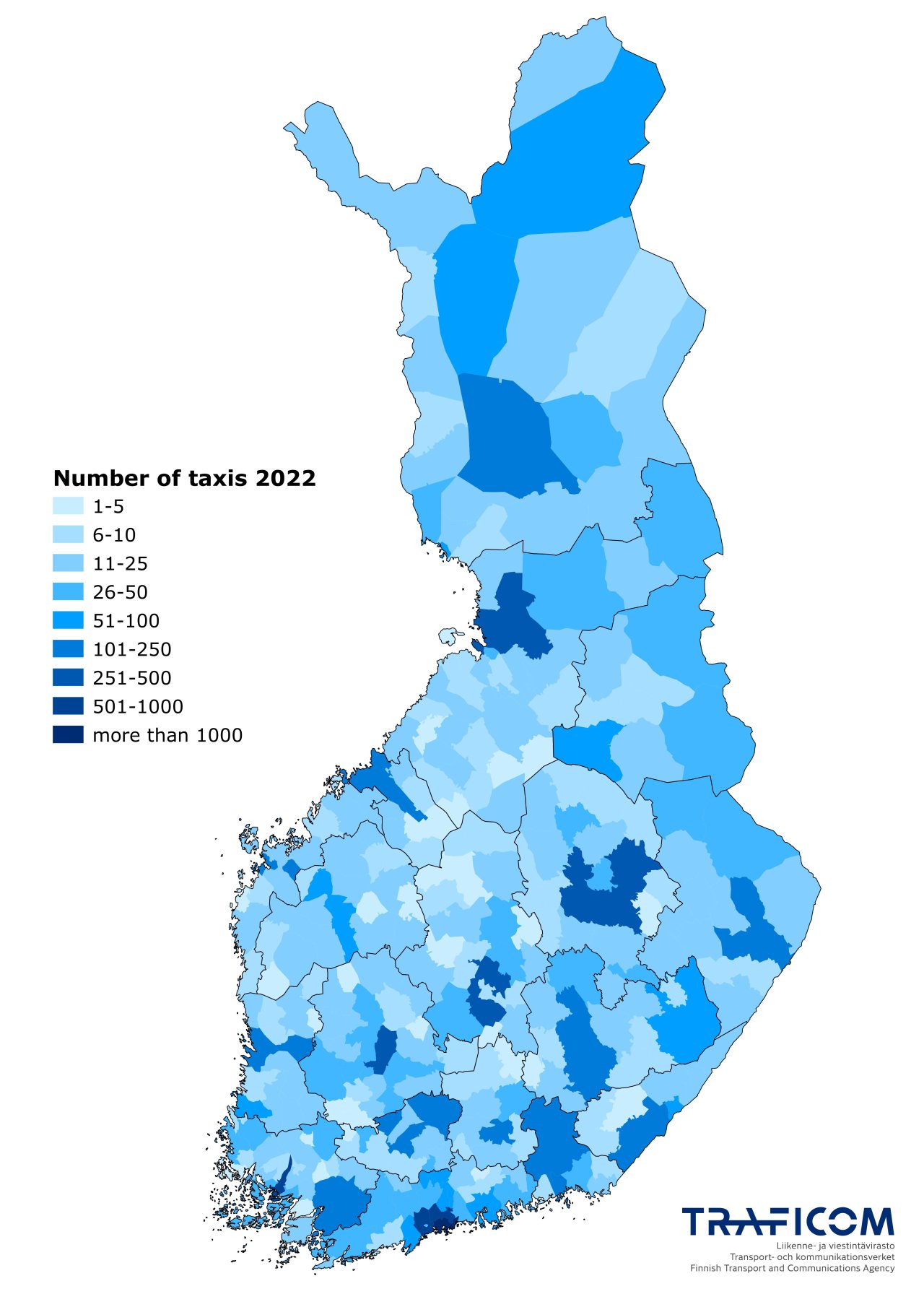
Caption: The number of taxis varies greatly between municipalities from one to up to a thousand.
Taxi order times shorter and more predictable in cities
The average ordering time for taxi services ordered through brokering services was approximately eight minutes in 2022 for the entire country. Average ordering times varied from seven to 13 minutes between regions. In addition to the length of the average ordering time, it must be noted how much ordering times varied from one order to another regionally. “It is easier for customers to predict ordering times in cities, because the variation is smaller on average there," says Kiiski.
Ordering times tend to be shorter on average during the week compared to the weekends. In cities, variation by hour and day is relatively small with average times of seven and nine minutes. The differences are far greater elsewhere; 9–14 minutes on weekdays and 14–21 minutes on the weekends. In cities, more than 90% of services arrive in 15 minutes both from Monday to Friday and on the weekends. This performance is poorer in sparsely populated areas. More than 75% of services arrive in fifteen minutes on weekday evenings and nights, whereas nearly 65% of the services at the same times on the weekends arrive in 15 minutes.
The Finnish Transport and Communications Agency Traficom started the regular collection of data on the taxi market in April 2022. The situational awareness of taxi service availability is based on the collected monitoring material and data from licence registers. The availability of services can be defined as the ability of supply to meet demand. Availability is examined from five perspectives, the first three of which (number of taxis, ordering time and number of taxi journeys in relation to population) are addressed in this bulletin and on the Data.Traficom page on availability statistics. The results of the survey on the service level of taxi services (Taksiliikenteen palvelutasokysely) carried out in late 2022 will be published in spring 2023 and the results concerning availability issues will be published in autumn 2023. Traficom has also published information on the supply and prices of taxi services in February and March.
Read more
Data.Traficom.fi Ulkoinen verkkopalvelu.
Taxi market is centralising – increases to the number of taxi vehicles and licences (press release 16.3.2023, content in Finnish)
Prices of taxi journeys have remained nearly the same – regional differences occur, however (press release 15.2.2023, content in Finnish)
Enquiries Tuomas Kiiski, Senior Specialist, tuomas.kiiski@traficom.fi, tel. +358 29 539 0631